About IgG4-related disease
What IgG4-related disease is
IgG4-related disease is a condition where the body's immune system causes inflammation and swelling, often forming lumps or enlarging organs. It can affect many parts of the body, sometimes more than one at a time.
Because it can form masses and swelling, it is often mistaken for other things, including cancer. This is one reason it can take a long time to diagnose. Getting the right diagnosis often changes everything, because the disease usually responds well to treatment, especially when caught early.
It is considered rare, and it is still becoming better understood. Specialists who know it can recognise its patterns.
Being told this might be IgG4-related disease can feel frightening, especially after hearing the word cancer. For many people, the diagnosis is the turning point, because this condition can be treated.
Where this comes from
Orphanet, IgG4-related disease (ORPHA284264). www.orpha.net
NHS / academic patient information and the ACR patient page. rheumatology.org/patients
How it shows up in the body
IgG4-related disease can affect many organs. Below are the areas it most often involves. Most people have only some of these, not all.
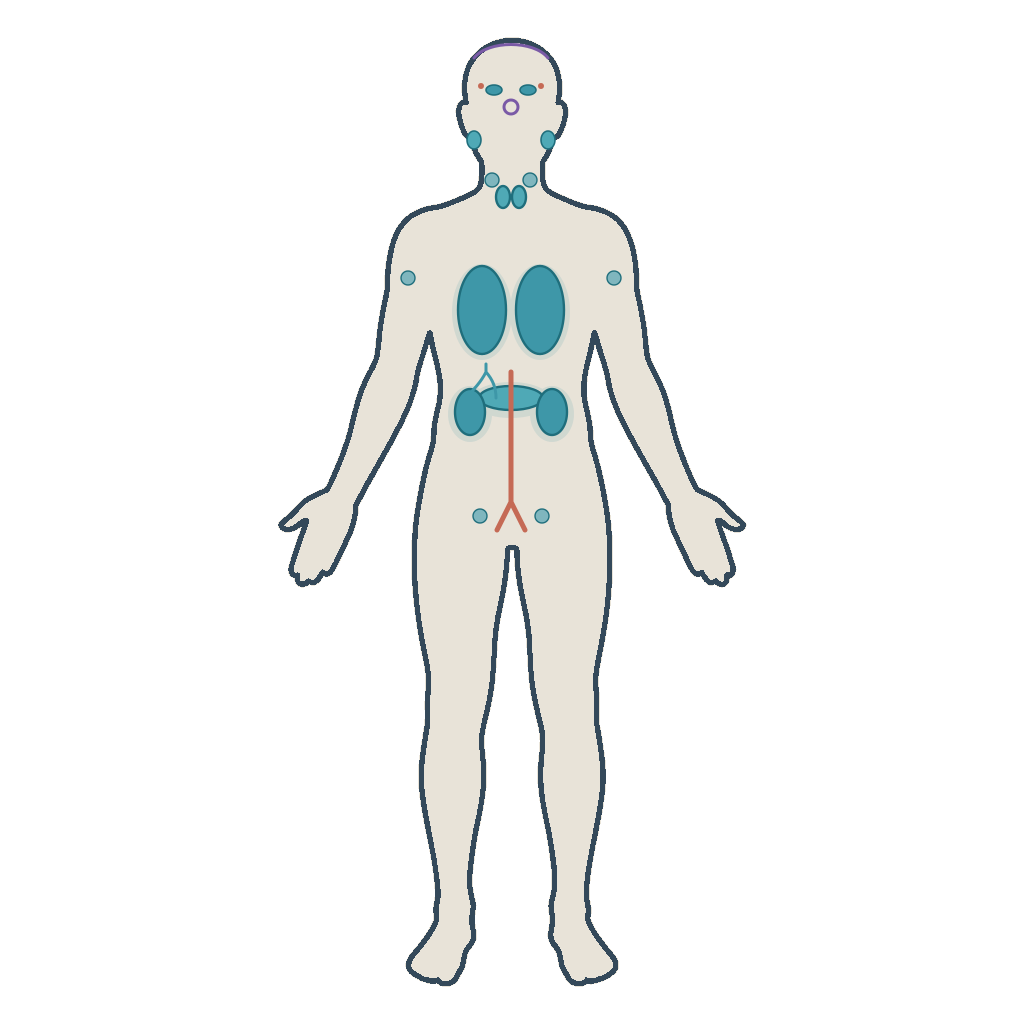
Areas IgG4 can affect
Commonly affected
- Eyes and tear glands
- Salivary glands
- Thyroid
- Lungs
- Bile ducts
- Pancreas
- Kidneys
- Aorta and retroperitoneum
- Lymph nodes
Less commonly affected · nervous system
- Meninges (brain and spinal cord lining)
- Pituitary gland
It can affect one or several of these. It varies from person to person.
Pancreas and bile ducts
Can cause a swollen pancreas (autoimmune pancreatitis) or inflamed bile ducts, sometimes with jaundice (yellowing of the skin or eyes). This is where it is most often mistaken for pancreatic cancer.
Salivary and tear glands
Can cause painless swelling of the glands around the jaw, in front of the ears, or around the eyes.
Eyes and the area around them (orbits)
Can cause swelling around the eyes, bulging, or affect the eye muscles.
Kidneys
Can cause inflammation that affects how the kidneys work.
Lungs and chest
Can cause nodules, or inflammation in the lungs or the lining around them.
The space behind the abdomen (retroperitoneum) and the aorta
Can cause a band of fibrous tissue to form (retroperitoneal fibrosis), sometimes affecting the large blood vessel called the aorta.
Lymph nodes
Can become enlarged, often without other symptoms.
Because it can appear in so many places, IgG4-related disease is easy to miss and easy to confuse with other conditions. A specialist who knows the disease can see the bigger picture across these areas.
Where this comes from
The 2019 ACR/EULAR classification work and Orphanet describe these organ patterns. www.orpha.net and the ACR patient page: rheumatology.org/patients
How IgG4-related disease is diagnosed
There is no single test that confirms IgG4-related disease. A specialist puts together several pieces, because the disease can look like other conditions. Knowing what these pieces are can help you understand your own journey and what to ask about.
Blood tests
A blood test can measure IgG4. Many people with the disease have a raised level, but some do not, and a raised level alone does not confirm it. It is one clue among several.
Imaging (scans)
Scans such as CT, MRI, or PET help find swelling, masses, or affected organs, and show which organs are involved and how extensive the inflammation is.
A tissue sample (biopsy)
Looking at a small sample of affected tissue under the microscope is often the most telling step. Specialists look for particular patterns that point to this disease rather than another.
Ruling out other conditions
Because it can resemble cancer or infection, part of diagnosis is carefully ruling those out. This is one reason the process can take time.
Putting it together
A specialist, often with a team across different fields, weighs all of these together. Doctors may also use agreed classification criteria as a guide. Those criteria are a tool for doctors, not a checklist for patients.
If this is being investigated for you, these are the kinds of steps you may go through. The right specialist is the person who can bring these pieces together and tell you what they mean for you.
Where this comes from
The 2019 ACR/EULAR classification criteria for IgG4-related disease (Wallace ZS, et al., Annals of the Rheumatic Diseases, 2020), Orphanet, and the ACR patient information. www.orpha.net and the ACR patient page: rheumatology.org/patients
This is a general description, not a diagnosis. The disease looks different in different people. Only a specialist can say whether it applies to you. If any of this feels familiar, that is a reason to ask your doctor.
Find a specialistHow IgG4-related disease is treated
IgG4-related disease often responds well to treatment, especially when it is caught early. The goal is to calm the inflammation, protect the organs it affects, and keep it from coming back. Treatment is always decided by a specialist who knows your case. What follows is a general picture, not a recommendation.
Steroids (corticosteroids)
For many people, a course of steroids such as prednisone is the usual first treatment. It often works quickly to reduce inflammation. A specialist manages the dose and how it is lowered over time.
Steroid-sparing and other medicines
Because long-term steroids carry their own burden, doctors may add or switch to other medicines that calm the immune system, so steroids can be reduced.
Rituximab
A treatment that targets specific immune cells. It has been widely used in this disease, particularly when it returns or when steroids are not enough.
A newly approved targeted treatment
In 2025, the first medicine developed specifically for IgG4-related disease was approved in both the United States and the European Union. In its trial, it substantially reduced the risk of the disease flaring. Whether it is right for any individual, and whether it is available and funded in their country, is a question for a specialist.
Watching for relapse
The disease can come back, so people are usually followed over time. Catching a relapse early keeps it manageable.
The most important step is being under the care of a specialist who knows IgG4-related disease. Treatment has improved a great deal, and for most people this is a condition that can be controlled.
Where this comes from
International consensus guidance on the management of IgG4-related disease (Khosroshahi A, et al., Arthritis & Rheumatology, 2015).
On the newly approved treatment: Stone JH, et al., Inebilizumab for treatment of IgG4-related disease, New England Journal of Medicine, 2025. doi.org/10.1056/NEJMoa2409712
European Medicines Agency and US FDA approval records, 2025.
New treatments are arriving in this disease. This page is kept up to date as that changes. None of it is a recommendation, and none of it replaces the advice of your own specialist.
This assistant shares sourced information and cannot diagnose you or replace your doctor. In an emergency, seek urgent care first.